Can You Stay at a Buddhist Monastery in Japan? What a Shukubo Is
A shukubo is a Buddhist temple that takes overnight guests. On Koyasan you get a tatami room, a vegetarian dinner and the monks' morning service.
Yes. A shukubo is a Buddhist temple that takes overnight guests, and on Koyasan, the Shingon monastery town in the mountains of Wakayama, more than fifty temples do: Yochi-in’s own page counts 52 of the mountain’s 117 subsidiary temples. You sleep on a futon in a tatami room, eat the monks’ vegetarian cooking, and may join the morning service in the main hall. You do not need to be a Buddhist; Eko-in, for one, welcomes guests of any religion.
See Shojoshin-in for your dates
A Temple, Not a Hotel
A shukubo is a working temple first. The monks hold their services and run the house, and guests fit into the temple’s day: an early dinner, a gate or a quiet hour at night, and a service at dawn. The rooms are Japanese-style, with tatami floors and futon bedding laid out for the night. Shojoshin-in puts a towel, a bath towel, a toothbrush, and yukata and tanzen robes in each room. Most rooms share a bath and toilet; a few temples sell rooms with their own. Some add a small welcome: Sekisho-in gives its guests a temple charm.
Shojoshin-in shows how old the tradition is. Its own page says Kukai, the founder of Koyasan, founded it in the Tencho era (824 to 834), and it stands at the Ichinohashi bridge, where the path into the Okunoin cemetery begins.
The Afternoon
Check-in starts in the afternoon: 14:00 at Eko-in, 15:00 at Rengejo-in, and from 13:00 at Fudo-in if you book on its own page. The hours before dinner are for the temple’s practices, which many include in the stay:
- Ajikan meditation. Eko-in holds it at 16:30 for about 40 minutes, free for guests; at Rengejo-in, guests may sit with the monks at 17:00.
- Sutra copying (shakyo). At Eko-in you do it in your room.
- Other crafts. Saizen-in offers prayer-bead making, and Fukuchi-in Buddhist colouring and paper cutting.
Shojoshin-in holds a goma fire ritual every day at 13:00 in its Hoosoden, open to anyone, which its guests can join before check-in or on the next day.
Dinner and the Evening
Dinner is early and fixed, and it is shojin ryori, the Buddhist vegetarian cooking of the monasteries, built on dishes such as sesame tofu and Koya tofu. Eko-in serves it in your room at 17:30; Rengejo-in in the main hall at 18:00; at Shojoshin-in guests eat together and gather by 17:30. Come late and you may lose the meal: at Eko-in, after 17:30 dinner is not prepared and the meal fee is not refunded.
After dinner comes the bath, shared and separate for men and women. Rengejo-in fills its bath with natural mountain spring water from 18:30 to 21:30. Then the temple goes quiet. Most close their gate in the evening, which matters if you plan to walk Okunoin at night.
The Morning Service
The service is the heart of the stay. It is held in the main hall before breakfast, and guests may join:
| Temple | Morning service | Fire ritual (goma) | |
|---|---|---|---|
| Koyasan Sanadabo Rengejoin | 06:00 in the main hall, with shomyo chanting | not stated | See dates |
| 清浄心院 -Shojo Shin-in- | 06:30, about an hour, in the Reihaido | 13:00 daily, open to anyone | See dates |
| Koyasan Shukubo Yochiin | 06:30, anybody can join | not stated | See dates |
| 高野山 宿坊 恵光院 -Koyasan Shukubo Ekoin Temple- | 07:00 in the main hall | 07:30 daily, guests welcome | See dates |
Fukuchi-in, which has no card here, holds its service free at 06:00 for about 50 minutes in its Ceremony Hall; see Fukuchi-in. Shojoshin-in holds a memorial for ancestors at its service, and its monks will give a Dharma talk or the temple’s history on request.
Breakfast follows, then check-out by 10:00 at most temples.
What to Wear and How to Behave
You need no special clothes. Rengejo-in asks guests to wear casual clothes, not the yukata, to the service and meditation, and Rengejo-in is strictly non-smoking. Arrive on time for dinner, keep to the gate time, and follow the monks’ lead in the hall.
A Guesthouse Is Not a Shukubo
Two lodgings on Koyasan are guesthouses, not temples. Kokuu and Tommy serve no temple dinner and hold no service; you can still walk to a temple ceremony that is open to anyone. For the temples side by side, see the temple comparison, and for what a night costs, the cost guide.
Choose Your Temple for the Night
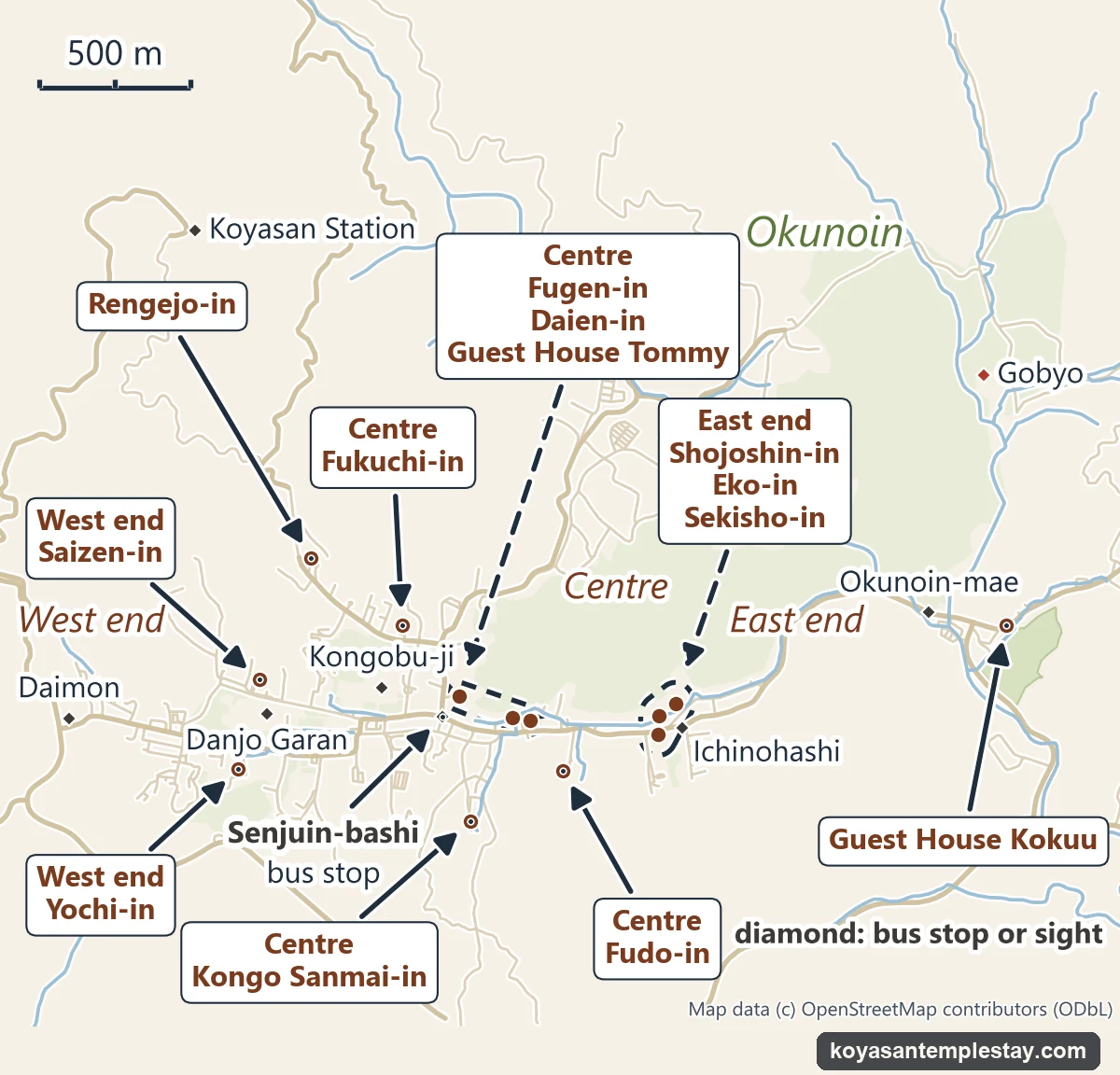
Every temple keeps its own hours, dinner and morning service. The cards set them out by end of town, each with its rooms for your dates.
See the Koyasan temples